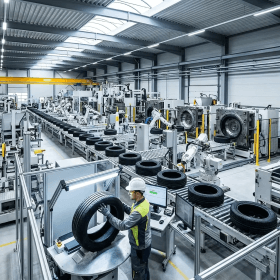
Every tire begins as a collection of raw materials—rubber, carbon black, steel, and dozens of chemical additives. Transforming these ingredients into a finished tire capable of enduring years of service requires a complex, precisely controlled manufacturing process. Understanding how tires are made reveals why they perform the way they do and why quality varies between brands.
Compounding and Mixing
The process starts with compounding. Technicians weigh and blend natural rubber, synthetic rubber, carbon black, sulfur, accelerators, antioxidants, and other chemicals according to proprietary recipes. Each compound is tailored for a specific tire component: tread, sidewall, bead, or inner liner. The ingredients are mixed in massive industrial mixers, called Banbury mixers, that blend and heat the rubber until it becomes a homogenous black mass. The mixed compound is then cooled and stored in sheets.
Calendering and Extrusion
The cooled rubber sheets proceed to calendering, where they are pressed between heavy rollers to form thin, uniform layers. Some layers are reinforced with fabric cords—polyester, nylon, or rayon—that give the tire its internal strength. Steel belts are also calendered, with steel wires embedded in rubber. Meanwhile, extrusion shapes other components. The tread is extruded through a die to create its final profile with grooves and sipes. The sidewall is extruded separately. The bead rings, made of high-tensile steel wire, are formed and coated with rubber.
Tire Building
Tire building is the most intricate stage. A building machine rotates a drum while an operator or automated system layers the components in precise sequence. First, the inner liner is applied, followed by the body plies—the fabric layers that form the tire’s carcass. The bead rings are positioned at the edges. Then the sidewalls, steel belts, and finally the tread are added. The result is a green tire—shaped like a tire but soft, uncured, and lacking its final strength.
Curing
The green tire moves to a curing press, where it is placed in a heated mold. An inflatable bladder presses the tire outward against the mold’s interior, which carries the tread pattern and sidewall markings. Under high temperature—typically around 150°C—and pressure, the rubber undergoes vulcanization. Sulfur cross-links the rubber molecules, transforming the soft green tire into a strong, elastic, and heat-resistant finished product. The curing process takes 15 to 25 minutes depending on tire size.
Inspection and Testing
After curing, each tire undergoes rigorous inspection. Workers visually check for defects. X-ray machines examine internal structures for misaligned cords or foreign objects. Balance and uniformity machines measure weight distribution and dimensional consistency. Some tires are randomly selected for destructive testing, including plunge tests, bead unseating tests, and high-speed endurance runs. Only tires passing all checks receive the final stamp of approval.
The Finished Product
The completed tire is trimmed, cleaned, and sorted for shipping. It carries the DOT date code indicating when it was made, the UTQG ratings, and all the size and specification markings that guide consumers. From raw materials to finished product, a single tire passes through dozens of hands and machines, each step contributing to the safety and performance that drivers depend on every day. The next time you drive, remember the journey your tires took before they ever touched the road.
Inside the Tire Factory: How a Tire Is Made
Every tire begins as a collection of raw materials—rubber, carbon black, steel, and dozens of chemical additives. Transforming these ingredients into a finished tire capable of enduring years of service requires a complex, precisely controlled manufacturing process. Understanding how tires are made reveals why they perform the way they do and why quality varies between brands.
Compounding and Mixing
The process starts with compounding. Technicians weigh and blend natural rubber, synthetic rubber, carbon black, sulfur, accelerators, antioxidants, and other chemicals according to proprietary recipes. Each compound is tailored for a specific tire component: tread, sidewall, bead, or inner liner. The ingredients are mixed in massive industrial mixers, called Banbury mixers, that blend and heat the rubber until it becomes a homogenous black mass. The mixed compound is then cooled and stored in sheets.
Calendering and Extrusion
The cooled rubber sheets proceed to calendering, where they are pressed between heavy rollers to form thin, uniform layers. Some layers are reinforced with fabric cords—polyester, nylon, or rayon—that give the tire its internal strength. Steel belts are also calendered, with steel wires embedded in rubber. Meanwhile, extrusion shapes other components. The tread is extruded through a die to create its final profile with grooves and sipes. The sidewall is extruded separately. The bead rings, made of high-tensile steel wire, are formed and coated with rubber.
Tire Building
Tire building is the most intricate stage. A building machine rotates a drum while an operator or automated system layers the components in precise sequence. First, the inner liner is applied, followed by the body plies—the fabric layers that form the tire’s carcass. The bead rings are positioned at the edges. Then the sidewalls, steel belts, and finally the tread are added. The result is a green tire—shaped like a tire but soft, uncured, and lacking its final strength.
Curing
The green tire moves to a curing press, where it is placed in a heated mold. An inflatable bladder presses the tire outward against the mold’s interior, which carries the tread pattern and sidewall markings. Under high temperature—typically around 150°C—and pressure, the rubber undergoes vulcanization. Sulfur cross-links the rubber molecules, transforming the soft green tire into a strong, elastic, and heat-resistant finished product. The curing process takes 15 to 25 minutes depending on tire size.
Inspection and Testing
After curing, each tire undergoes rigorous inspection. Workers visually check for defects. X-ray machines examine internal structures for misaligned cords or foreign objects. Balance and uniformity machines measure weight distribution and dimensional consistency. Some tires are randomly selected for destructive testing, including plunge tests, bead unseating tests, and high-speed endurance runs. Only tires passing all checks receive the final stamp of approval.
The Finished Product
The completed tire is trimmed, cleaned, and sorted for shipping. It carries the DOT date code indicating when it was made, the UTQG ratings, and all the size and specification markings that guide consumers. From raw materials to finished product, a single tire passes through dozens of hands and machines, each step contributing to the safety and performance that drivers depend on every day. The next time you drive, remember the journey your tires took before they ever touched the road.
Contact Yihang Tires for videos of tires production or introduction if you are interested in!